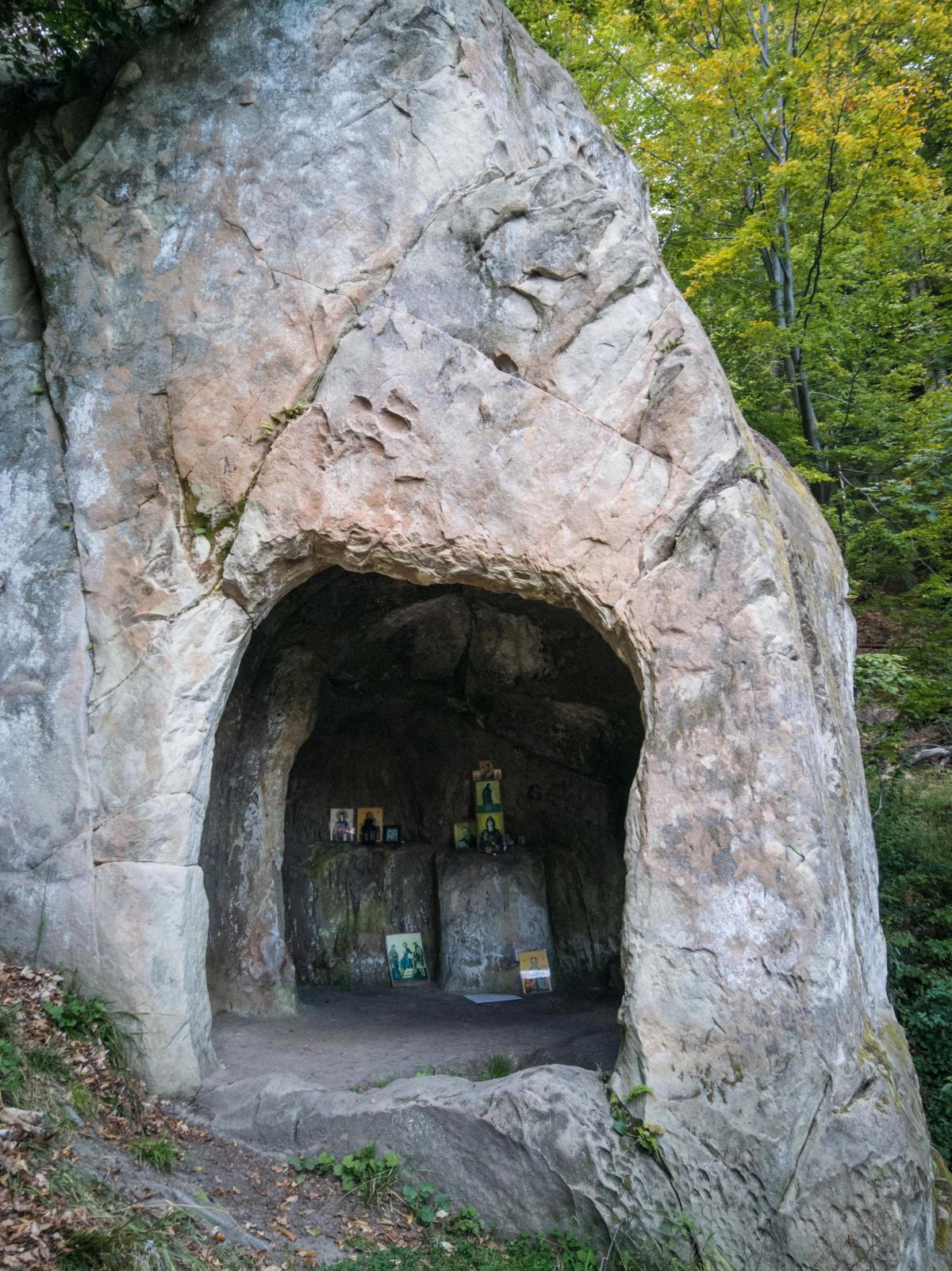
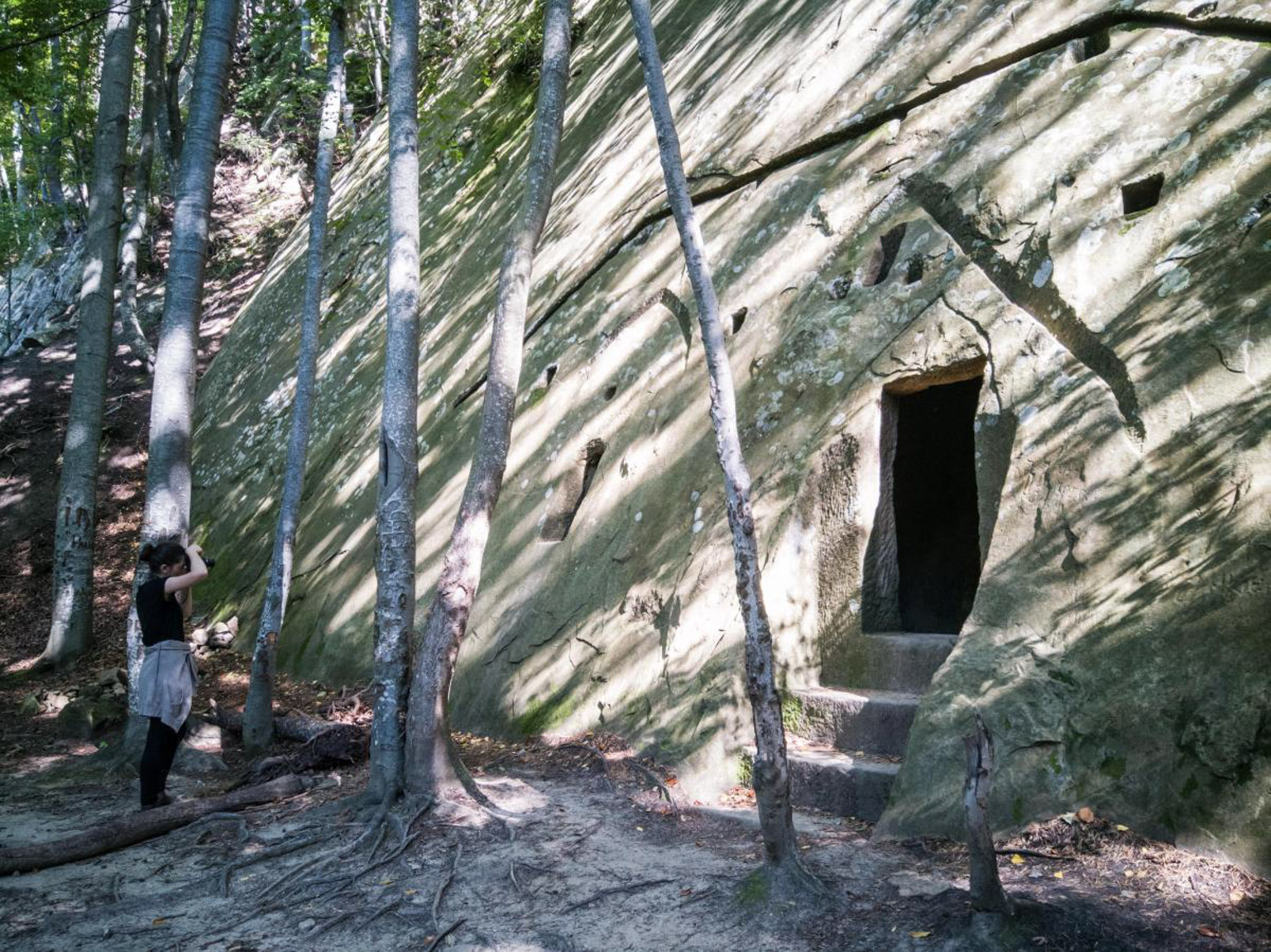
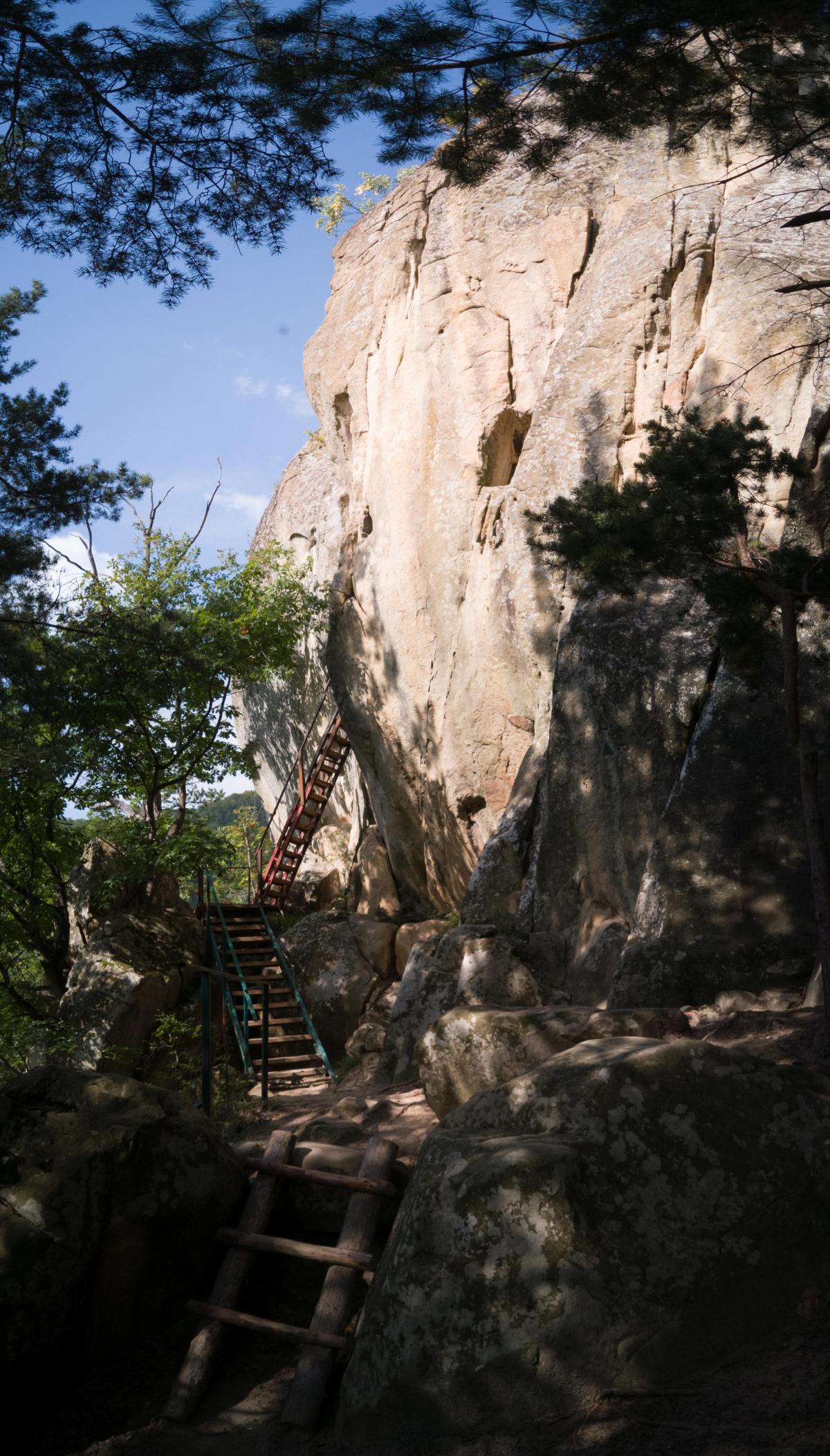
The cave churches in the Buzău Mountains represent a complex ensemble of architectural remains carved into the rock, with predominantly cultic and refuge functions, whose history extends, through some traces, to prehistory. They are located in the southeastern arc of the Carpathians, with a high density around the Ivănețu Peak, but also on the right bank of the Buzău River, in the Siriu Massif, as well as in the Curvature Subcarpathians (Botan Hills), over an area of over 80 km. Most of these structures, approximately 30 in number, are found around the communes of Bozioru, Colți, Cozieni and Brăești, but also to a lesser extent in Cătina, Sibiciu and Nehoiu.
Although most of these isolated structures appear to have been carved into the rock during the medieval period, archaeological research has revealed traces of habitation dating back to the Bronze Age (Monteoru culture) or the beginning of the First Iron Age (Hallstatt). The first documentary mentions of these structures appear only in the 16th century, when anchoretism — an Orthodox monastic movement that involved the construction of churches and cells in stone — gained momentum in the mountainous area of Buzău. Many of these cave complexes served as places of worship, cells or places of prayer, the best known being the Aluniș Hermitage (still functional) and the Agaton Hermitage. In addition, numerous caves in the area feature inscriptions and cave drawings with predominantly Christian themes.
The lack of detailed documentary information and the often enigmatic appearance of the cave complexes have generated a rich literature that places their dating both in prehistory and, especially, in the early period of Christianity (3rd-4th centuries). There are diverse and controversial opinions that support the presence of cave archaeological evidence associated with early Christianity, while well-documented statements confirm the area as a center of Christian confession later, towards the middle of the second millennium. A theory with uncertain support circulates the idea that the missionary Audius, founder of the Audien sect, would have been active in the Buzău area. Some local researchers go even further, claiming that certain sites would have served as Dacian sanctuaries.
In addition to their cultic role, these locations also served as places of refuge, both destinations being supported by their isolated location, the presence of inscriptions and medieval documentary mentions. Indirectly, the cave churches influenced the dynamics of human settlements. The emergence of isolated hermits led to the establishment of small hermitages and, subsequently, to the development of a flourishing monastic community in the feudal period. The initial anchorite organization was transformed into a cenobitic one through voivodeship interventions, fundamentally changing the life of the hermits. Monasteries with a coordinating role were established, some of them being successors of older hermitages. This phenomenon contributed to the disappearance of many of them, because with the secularization of monastic assets in 1864, the monastic communities dissolved. In their wake, small hamlets remained that declined with the disappearance of monastic life and survived, in most cases, until the first two decades of the 20th century. Although in some information media the name "Romanian Athos" is used for this area, the comparison has no real support, according to in-depth studies.
The main access to the site area is provided by the DN10 Buzău-Brașov. Since the area is wild and vast, markings and maps often prove useless. The settlements are accessible on foot or horseback, with a few people who can offer guide services. Marked and approved tourist routes, notes, signs and professional promotion of these places are largely lacking, thus limiting the tourist potential.
The complex of cave vestiges in the Buzău Mountains extends over a length of over 80 km, with a significant presence around the communes of Bozioru, Colți and Brăești (Ruginoasa village). Other similar arrangements are found in Cozieni, Cătina, Sibiciu and Nehoiu, totaling approximately 30 sites that served both as living spaces and as places of worship. Archaeological evidence indicates various periods of habitation, with some sites being used as early as the Bronze Age or early Iron Age, while documentary evidence only begins in the 16th century. The area lies between 45.25-45.45 degrees north latitude and 26.20-26.55 degrees east longitude.
The first written mentions of these cave complexes appear in the mid-16th century, in documents issued by the chancelleries of the voivodes of Wallachia, such as Radu de la Afumați and Mihnea Turcitul. Systematic research began in the summer of 1871, when Alexandru Odobescu launched an "Archaeological Questionnaire" and led a "Campaign for Archaeological Explorations in the Buzău District", accompanied by the Swiss painter Henri Trenk. They created an album of reliefs and watercolors, preserved at the Library of the Romanian Academy. The first researcher to analyze and popularize these settlements was the Buzău professor Basil Iorgulescu, between 1890 and 1891, publishing the "Geographical, Statistical, Economic and Historical Dictionary of Buzău County" (1892), which contains detailed descriptions and observations on the inscriptions. Notable subsequent contributions were made by N.A. Constantinescu (1924), Mihai Regleanu, Nicolae Stoicescu, and Pavel Chihaia, who published articles such as "A complex of hermits in the Buzău Mountains during the time of Neagoe Basarab" and "New data on the cave churches in the Buzău Mountains". In the 1980s, archaeologists Vasile Drâmboceanu, Vasile Boroneanț and engineer Paul Lazăr Tonciulescu stood out.
The cave settlements in the Bozioru (Nucu) - Brăești (Ruginoasa) - Colți (Aluniș) area are located on the Ivănețu peak, a Paleogene spur oriented northeast - southwest, which extends the mountain area to an altitude of about 1000 m, with peaks such as Arsenie (1115m) and Zboiul (1115m) exceeding this elevation. The communication routes converge from west to east, following the tributary valleys of the Sibici (Colți – Aluniș) and Bălăneasa (Bozioru – Nucu and Brăești – Ruginoasa) hydrographic basins, which upon leaving the mountain area enter the central group of the Buzău Subcarpathians, between the Buzău and Slănic rivers (Botanului hills). The friable nature of the Kliwa sandstone, specific to the area, facilitated the digging of habitable caves. The Cozieni - Pănătău area belongs to the Botanului hills and, more precisely, the Muscelului hills (between the Sibiciu and Bălăneasa valleys), and the caves near Nehoiu are located either on the right bank of the Buzău, in the Siriu Massif, or on the left (Ivănețu spur).
The evolution of the church in the Romanian Lands before the establishment of the Romanian Orthodox Church, according to historians such as Iorga, Popescu and Popp, is marked by various periods. Between the Buzău valley and the lower Siret valley, there was a union of Getic tribes during the pagan period.
In the Roman era, when Christianity began to penetrate north of the Danube through the Roman legions, the Buzău area represented an important route for the circulation of material goods between Dobrogea (part of Moesia Inferior) and Transylvania (Roman Dacia). According to some controversial opinions, some cave settlements in the Aluniș – Nucu area could date from the 3rd-4th centuries AD, a period of affirmation of Christianity north of the Danube. It is certain that in that era there were Christians in the Buzău valley, as well as an organized church life, with churches, priests and bishops. Preached north of the Danube by an active Orthodox mission, directed by the ecclesiastical authorities of Scythia Minor and Cappadocia (through the care of Saint Basil the Great), Christianity spread among the Goths, but led to unrest due to conversion to Arianism. Athanaric, a follower of Germanic pagan beliefs, initiated bloody persecutions against the Christian Goths, among the victims of which was the martyr Sava the Got ("Saint Martyr Sava of Buzău"). As a result, the first Arian bishop Wulfila (Ulfilas) withdrew in 348 with a group of believers to the north of present-day Bulgaria.
The period of migrations did not bring a complete disorganization of the local Church institution after Ulfilas' departure, with Bishop Goddas succeeding him between 347-380. The cave settlements would have served as places of refuge during invasions.
During the medieval period, the 16th century marked the development of anchorite monasticism in the area, with hermits establishing cells and places of worship in caves. These small communities evolved into hermitages and monasteries, influencing the dynamics of human settlements. In the 17th century, voivodeship interventions transformed monastic life from anchorite to cenobitic, with the establishment of community-type monasteries with a coordinating role. This contributed to the decline and, ultimately, the disappearance of many cave hermitages, especially after the secularization of monastic assets in 1864, which led to the dissolution of monastic communities and their transformation into small hamlets, most of which disappeared by the 20th century.
Specific areas and sites
The cave complex in the Buzău Mountains is divided into several areas, each with specific sites:
* Colți-Bozioru: This area is the richest in cave remains.
* Aluniș Ensemble: One of the most important and the only one that still functions as a church today. It has a complex history, with phases of habitation in prehistoric times, transforming into a Christian place of worship in the Middle Ages.
* Agaton Hermitage: Another important site, with vestiges of cells and a cave church, considered a monastic center in the past.
* Joseph's Cave: A cave that would have served as a place of hermitage for a hermit, being documented.
* Fundătura Hermitage: Another cave ensemble that had a monastic function.
* Porfirie Hermitage: Considered a place of hermitage.
* Piatra Şoimului cave hermitages: A group of cave arrangements with a monastic character.
* Isolated cells and other anthropic caves: Numerous other cavities, used by hermits or as shelters.
* Brăești: The area also hosts several man-made caves.
* Căsoaia Cave: A landscaped cave, with possible functions of habitation and refuge.
* Culmea Pietrei Cave: Another cave landscape.
* Piatra Îngăurita Cave (2): A cave marked by human presence.
* Policiori Cave: A site with traces of habitation.
* Ușa Pietrei Cave: A cave with a distinctive entrance.
* Cozieni - Pănătău - Nehoiu: This area completes the ensemble.
* Malul cu Gaura Cave: A cave with a large opening, used as shelter.
* Vârful Câmăruței Cave: Another landscaped cave.
* Înțelăției Cave (Piatra Înțelăției): The name suggests a certain characteristic of the cave.
* Gaura Tătarilor Cave: The name indicates a possible use as a place of refuge during invasions.
There are numerous controversies and ambiguities related to the cave churches in the Buzău Mountains.
* The cave complex and the phrase Romanian Athos: Although the comparison with Mount Athos is popular in certain circles, most researchers and specialists consider that this is not supported by reality, there being significant differences in terms of monastic organization, history and role.
* The cave complex and paleochristian origins: There is intense debate regarding the dating of some of the sites to the paleochristian period (3rd-4th centuries). Some historians support this hypothesis based on archaeological evidence, while others consider the evidence to be insufficient or ambiguous, indicating a later Christian use.
* The cave complex and the Audien missionaries: The theory that the missionary Audius and the Audien sect were active in the Buzău area is circulated, but it does not have solid historical support and is viewed with skepticism by most researchers.
* The cave complex and the relationship with Dacian sanctuaries: Some local researchers advance the idea that certain sites could have served as Dacian sanctuaries. This hypothesis requires additional archaeological research and more conclusive evidence to be widely accepted.
* Artifacts with uncertain dating and significance: Many of the artifacts discovered in the cave sites are difficult to date and interpret, contributing to uncertainties related to the history and initial function of these sites.
* Future research directions: A multidisciplinary approach is needed, with in-depth archaeological studies, historical analyses and comparisons with other similar sites, to elucidate the mysteries that still surround the cave complex in the Buzău Mountains.
Despite its historical and cultural importance, the area's tourism potential is underexploited. Access to many sites is difficult, lacking adequate tourist infrastructure, such as marked trails, signposts and professional promotion. Visiting these places often requires knowledge of the terrain or the help of a local guide.
In conclusion, the cave churches of the Buzău Mountains represent a cultural and historical heritage of inestimable value, a meeting place between nature and spirituality, with a complex history spanning thousands of years. From the first prehistoric settlements to medieval monastic communities, these caves and cells carved into the rock have witnessed profound social and religious transformations. Although many aspects remain shrouded in mystery and controversy, the cave complex continues to fascinate and provide fertile ground for future research, essential for the full understanding of this unique chapter in Romanian history.

4 out of 5 stars
based on 0 reviews
If you’ve visited this place, share your thoughts with others
write review