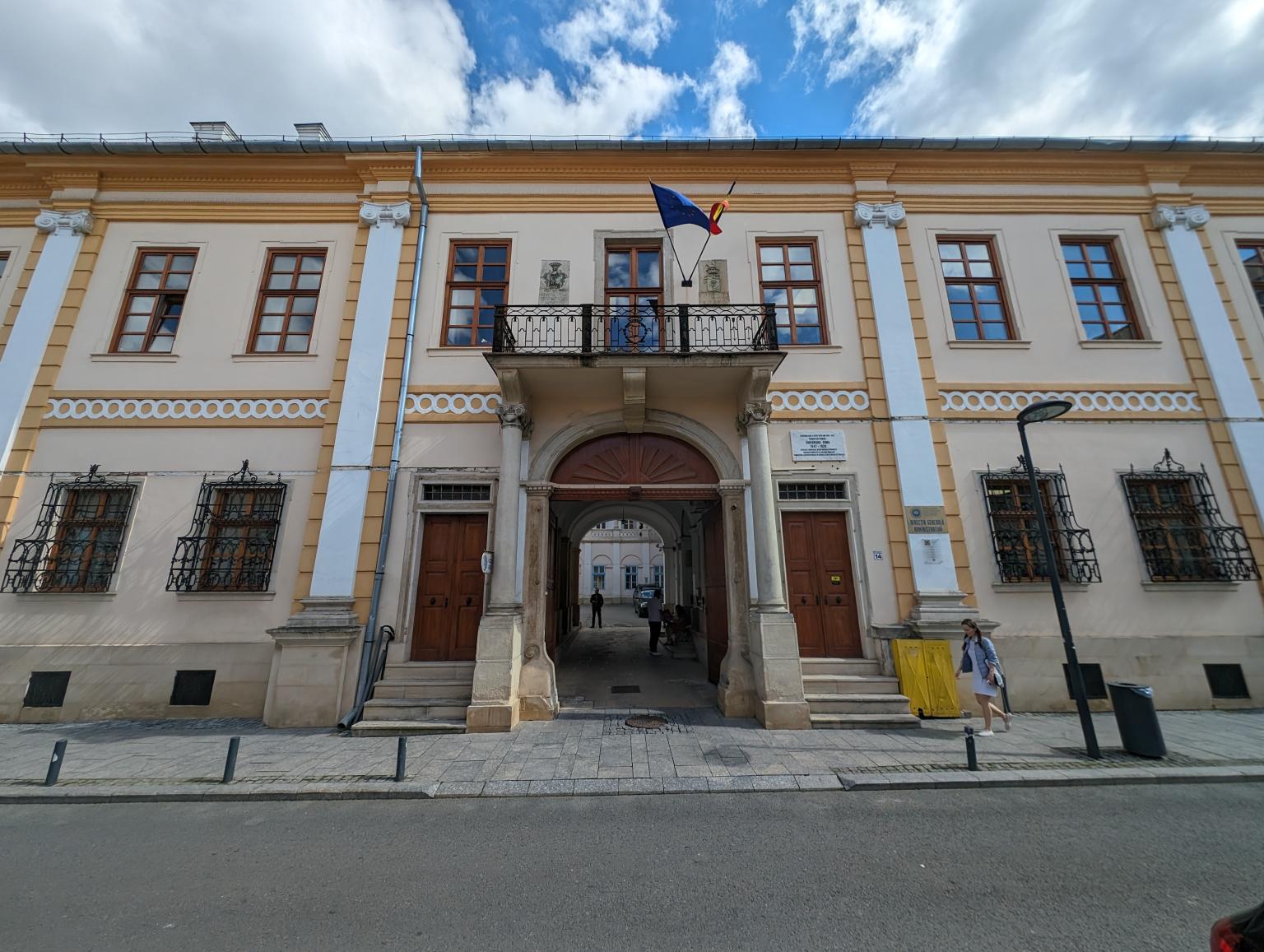
At the intersection of the streets I.C. Brătianu and Hermann Oberth is a baroque building, which was once the residence of an important noble family from Cluj, composed of Count Laszlo Toldalagi and Countess Anna Korda.
The most recent owner of the building was the writer and politician Miklos Banffy. Over time, the composer Gheorghe Dima also lived here.
The palace was built between 1801 and 1807 according to the projects developed by the Italian architect Carlo Justi. The construction represents one of the most beautiful buildings in the city, marked by the transition from the Baroque to the Classical style. At the entrance, we see columns with Ionic capitals, and above the entrance are carved coats of arms representing the two families.
A commemorative plaque recalls that between 1919 and 1925, the composer Gheorghe Dima, a prestigious figure in the Romanian musical school, lived here.
Born in 1847 in Brașov to a merchant family, Gheorghe Dima began his high school studies in Vienna, then was sent to Karlsruhe to study engineering, which he abandoned in favor of music, studying with the teacher Giehne and later in Vienna with Professor Hoffman. He then attended the Graz Conservatory, where he studied harmony and counterpoint with Professor Thieriot, continuing his training at the Leipzig Conservatory between 1872-1874.
Becoming a soloist in concerts in Karlsruhe, Leipzig and Vienna, in 1874 he returned to Brașov, where he was a teacher at the Central Romanian Schools until 1878. He obtained his composition diploma in 1880, after which he returned to the country to work as a teacher and conductor in Sibiu. In 1899, he returned to Brașov as conductor of the church of Saint Nicholas in Șchei and director of the Reunion of gymnastics and singing.
In 1916, he took refuge in Bucharest, being later caught and imprisoned by the Hungarian authorities. In 1920, he was appointed director of the first Romanian conservatory in Transylvania, in Cluj.
Gheorghe Dima devoted himself mainly to the genre of vocal music, composing songs for voice and piano, a cappella choirs and with orchestra. He processed popular melodies and old Romanian songs, including choral creations such as "Ce te legeni codrule" and "La midud de codru des" (Eminescu). Among his notable works are the cantatas "Hora" (Alecsandri) and "Mama lui Ștefan cel Mare" (Bolintineanu), standing out in contrapuntal art.
However, his creation of lieds, especially those composed on Eminescu's lines, such as "Why don't you come to me", "Somnoroase păsărele", "Dăcă ramuri bat în giam", "Desire" and "Se bate midnight," places him above his contemporaries. These lieds are distinguished by the fact that the piano participates as an equal partner of the voice in expressing the poetic ideas of the text, representing true culminations of his creation.
Currently, the palace functions as an administrative building of "Babeș-Bolyai" University.
Source: City of Cluj-Napoca and surroundings (Ministry of Tourism, 1982)