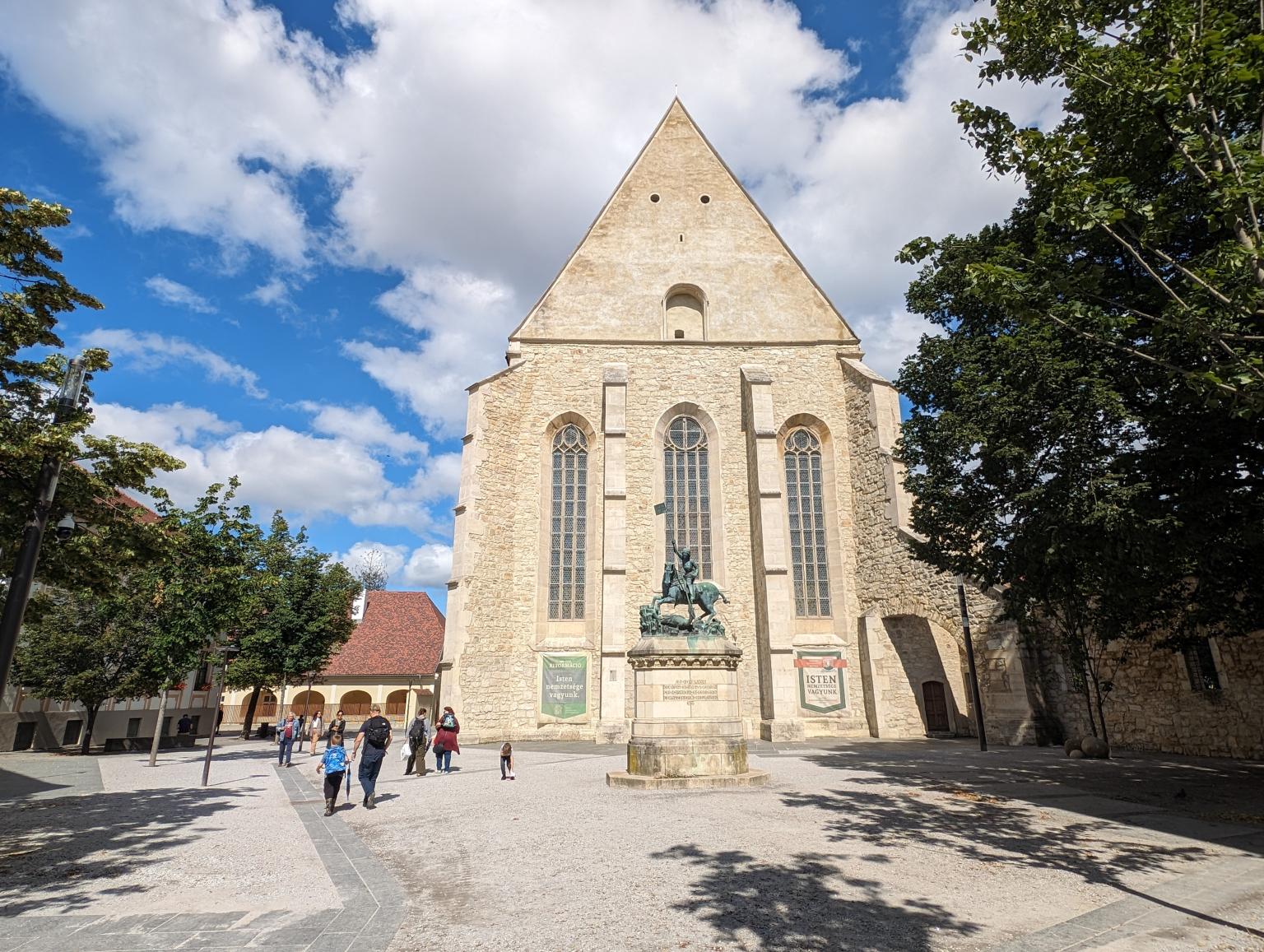
The Matia Church was originally built as a church of the Franciscan Minority Monastery, with the beginning of the works in 1486, at the instigation and with the support of Matei Corvin.
The building, made in the late Gothic style, impresses with its massive dimensions; the nave is 15-16 meters wide, and the buttresses contribute to the appearance of a fortress.
This reformed church is characterized by the fact that it is a unique, extremely long hall with an elongated choir and a pentagonal altar. The vaults of the choir, without ogives, have ribs bundled in the form of a star, suggesting a transition to the trellis vault and having a decorative character specific to the late Gothic style.
Despite its simple appearance, the church features decorative elements, including the consoles next to the triumphal arch, inspired by wood carvings and showing folk art influences.
The trussed vaults, added in the 17th century by Courlandian craftsmen, largely reproduce the appearance of the originals, which collapsed in 1603, except for a shorter arched section. The nave's sober decor, the result of 17th-century restorations, reveals late renaissance influences.
The pleasant appearance of the church is accentuated by the rough stonework visible on the outside after the last renovation, as well as by the gradual arrangement of the buttresses, which divide the building into harmonious units, most of which have decorations.
Through its austere and unitary conception, the Matia church managed to establish itself among the edifices of the time, being considered by some visitors (Giovani Argenta) as the most beautiful in Transylvania.
Inside, the church houses numerous objects of artistic value, among which are the pulpit made in 1946 in the Renaissance style in Transylvania by the Sibian sculptor Elias Nicolai and the craftsman Benedict, as well as the wooden furniture made by craftsmen from Bistri in the 15th century. The building underwent several renovations, the first time in the 18th century through the donation of Stancai Buicescu, and the second time in 1964, under the care of the historical monuments department.
One of the most special art objects is the pulpit from the 17th century, made by a Polish sculptor. The church houses one of the largest organs in Transylvania, which is functional and hosts classical music concerts during the summer. Inside the church, there is the most important collection of funerary coats of arms of the Hungarian nobility in Transylvania. Also, the church is the burial place of the last two princes of Transylvania, Mihail Apafi I and Mihail Apafi II, who are buried with their wives inside this cathedral.
The ruins of the cloister in the vicinity of the reformed church belong to a former Jesuit college, whose foundation document dates from 1581.
This college had 3 faculties - theology, philosophy and law - and awarded graduates the titles of baccalaureate, master and doctor. These titles gave the young men the same rights and privileges as those obtained at the Italian, French, Spanish and German academies. The institution functioned until 1603, when, following an anti-Jesuit action, the monks were expelled from Cluj, and with their departure, the college's activity ended.
In 1609, the Calvinists established an academic school, with Apáczai Csere Janos as director and teacher, after he was removed from the college of Alba Iulia in 1655, because of his anti-feudal ideas.
The college was completed with a seminary, a sort of dormitory for higher level students, especially the poor, according to the regulations drawn up by Antonio Possevino, its first head. A boarding school was also established for younger students. In 1985, the seminary had 85 students and the boarding school housed 80 students. Young people from Wallachia also studied at this college, including Nicolae Petrașcu, the son of Mihai Viteazul.
Source: City of Cluj-Napoca and surroundings (Ministry of Tourism, 1982)