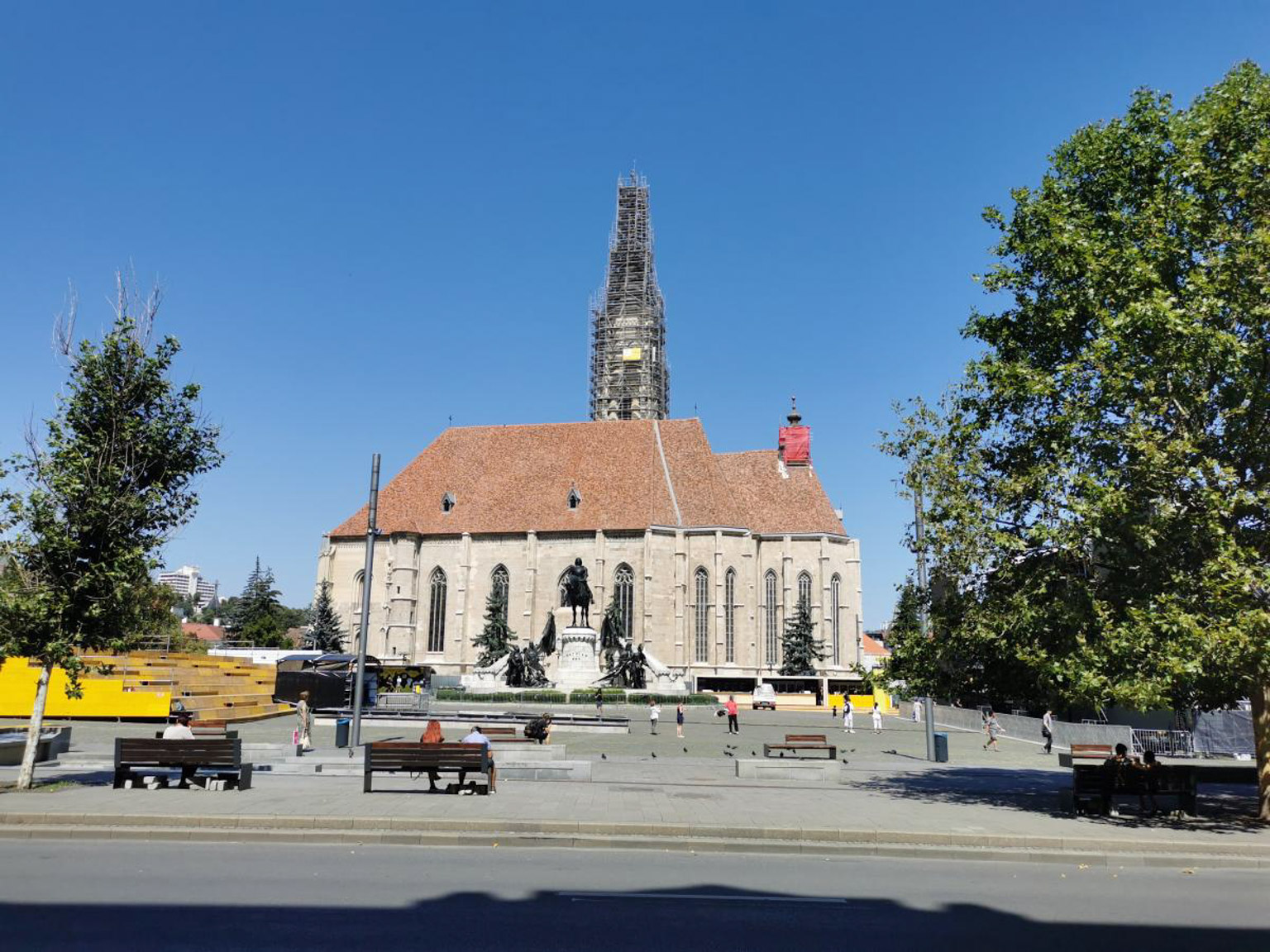
"St. Mihail" Church in Cluj-Napoca is an important historical and religious monument, built in the 14th century. It is located in Piața Unirii, in the center of the city, and is a representative example of Transylvanian Gothic architecture.
The architectural monument, due to its proportions and beauty, is considered one of the most impressive Gothic buildings in our country. It is particularly notable for its grand exterior and star-vaulted interior. Multicolored stained glass windows and Renaissance-style sculptures add complexity and appeal to this monument.
The church is first mentioned in a papal document from 1349, which was issued to raise the necessary funds to start construction. It appears that work began fairly quickly, on the site of a cemetery chapel documented as far back as 1350.
The construction of the church lasted almost 130 years, between 1350 and 1487, forming a complex of phases and aspects of the mature and late Gothic of the mid-16th century and the following century. Originally conceived as a Gothic basilica without a transept, in the first phase of construction, the choir was added to the church accompanied by side altars.
In the second phase, also dated to the mid-14th century, the original plan was modified, transforming the church into a hall and bringing improvements to the already existing part.
The third period of construction, between 1410 and 1430, saw the raising of the outer wall from the north, with decorated buttresses on the upper floors. In the final stage of construction, the northwest tower was added, completed between 1511 and 1543. Due to weathering and earthquakes, the tower was demolished in the 17th century. The last works included raising the upper half of the side nave and the nave vaults.
The final construction represents the first complete example of a hall church in Transylvania. The chancel with cross vaults on ogives, supported by slender pilasters, and the rich decoration of the capitals, with leaves, animal motifs and figurative scenes, reflect the classical elements of the High Gothic. Late Gothic is highlighted by the star-shaped vaults of the three naves, supported by strong pillars, and the decorative details of the windows and buttresses.
The western facade features lace buttresses at the top, the influence coming from the 16th century Austrian environment. The north, south and north-west portals, with braces or lobed arches, are rectangular in shape and derive from the South German environment of the same period.
The west-facing main portal is finished in a tall bracket and features in its center the venerated representation of the archangel Saint Michael.
Throughout its history, the church suffered from several fires in 1489, 1655 and 1697, as well as earthquakes, requiring repeated repairs. Between 1836 and 1862, an 80-meter high tower was added to the northern part of the facade, built in the Neo-Gothic style. Originally, the church was surrounded by walls, but these were demolished at the beginning of the 20th century.
The sculptures that decorate the capitals of the pilasters in the choir, dated between 1370 and 1380, show acanthus, vine, oak and sunflower leaves in the predominant vegetal decoration, frequent motifs in the early and late Gothic. In addition to these, there are masks and figures, isolated or brought together in small narrative scenes inspired by real life. The scriptural theme condenses the idea of salvation, starting from the biblical pretext of the fall into sin and expulsion from heaven, followed by the allusive depiction of vices and ways to eternal life: prayer, teaching, work. The images, though naive, are honest and animated by a certain anecdotal impulse, reflecting authenticity through the faithful representation of the costumes. Among the episodes expressed, a hunting scene stands out, a peasant milking his goat, a townswoman, a teacher and his student, a stonemason wielding a chisel and a hammer.
The sacristy door, carved in 1528 in the Renaissance style, is particularly beautifully ornamented. Fragments of frescoes were also discovered during the restorations. In the Schleynig Chapel, which evokes episodes from the passion cycle between the years 1410-1420, stylistic influences from northern Italy can be seen through the Tyrolean and Bohemian atmosphere.
The outstanding painting on the wall of the south aisle, representing the Virgin and Child surrounded by a series of holy figures, made in the second part of the 15th century, is executed in a heavier style, lacking in cursive. In the southern apse, dated at the beginning of the 16th century, there are representations of Saint Sebastian, a pope, etc., with more evolved elements that highlight the first echoes of the renaissance in Cluj painting.
In the basement of the church there is a crypt, which houses the graves of some personalities from Transylvania, such as King Matthew Corvin, princes Sigismund Báthory, Sigismund Rákóczi, Gabriel Báthory and Gabriel Bethlen.
"St. Mihail" church witnessed important events in the history of Transylvania. Numerous sessions of the Diet of Transylvania were held in it, and Transylvanian principles were invested in it.
Source: City of Cluj-Napoca and surroundings (Ministry of Tourism, 1982)