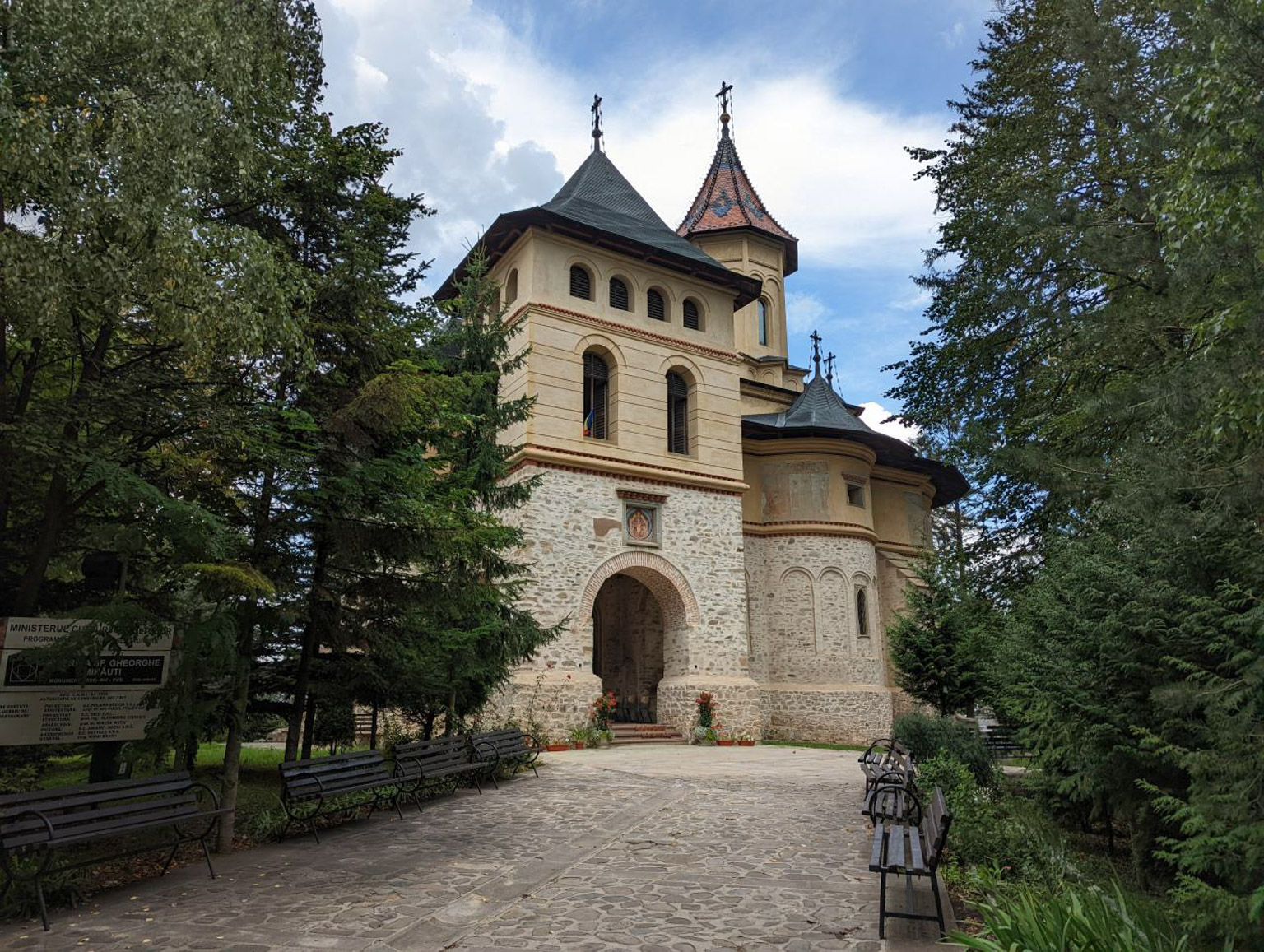
The Mirăuți Church was built in the 14th century by Voivode Petru Mușat and served as the first seat of the country's metropolitan until the construction of the new metropolitan cathedral, St. George, by Bogdan III.
According to the legend, together with the construction of the Suceva fortress in the vicinity, the Mirăuți church was also built, connected by a bridge made of buffalo skins, crossed by the princely processions on the occasion of the coronation and anointing ceremonies of the voivodes. The name of the church comes from the solemn ceremony of anointing, carried out with pomp by the metropolitan of the country.
Over time, the church suffered significant damage, and its current appearance, according to the architectural and decorative features, reflects a construction specific to the first half of the 17th century. The restoration from 1898-1901 was coordinated by the architect Romstorfer.
The church has a triconical plan, with the bell tower added to the south wall of the nave. In the architecture, there are elements specific to a new stage of the Moldavian style, such as the dividing pilasters between the nave and the pronaos, the belt of mountain origin (on the outside), surrounded by two rows of bricks in the shape of teeth, as well as the semicircular colonnades integrated into the arches and braced windows.
Source: Bucharest-Suceava and in Northern Moldova (Ministry of Tourism, 1977)