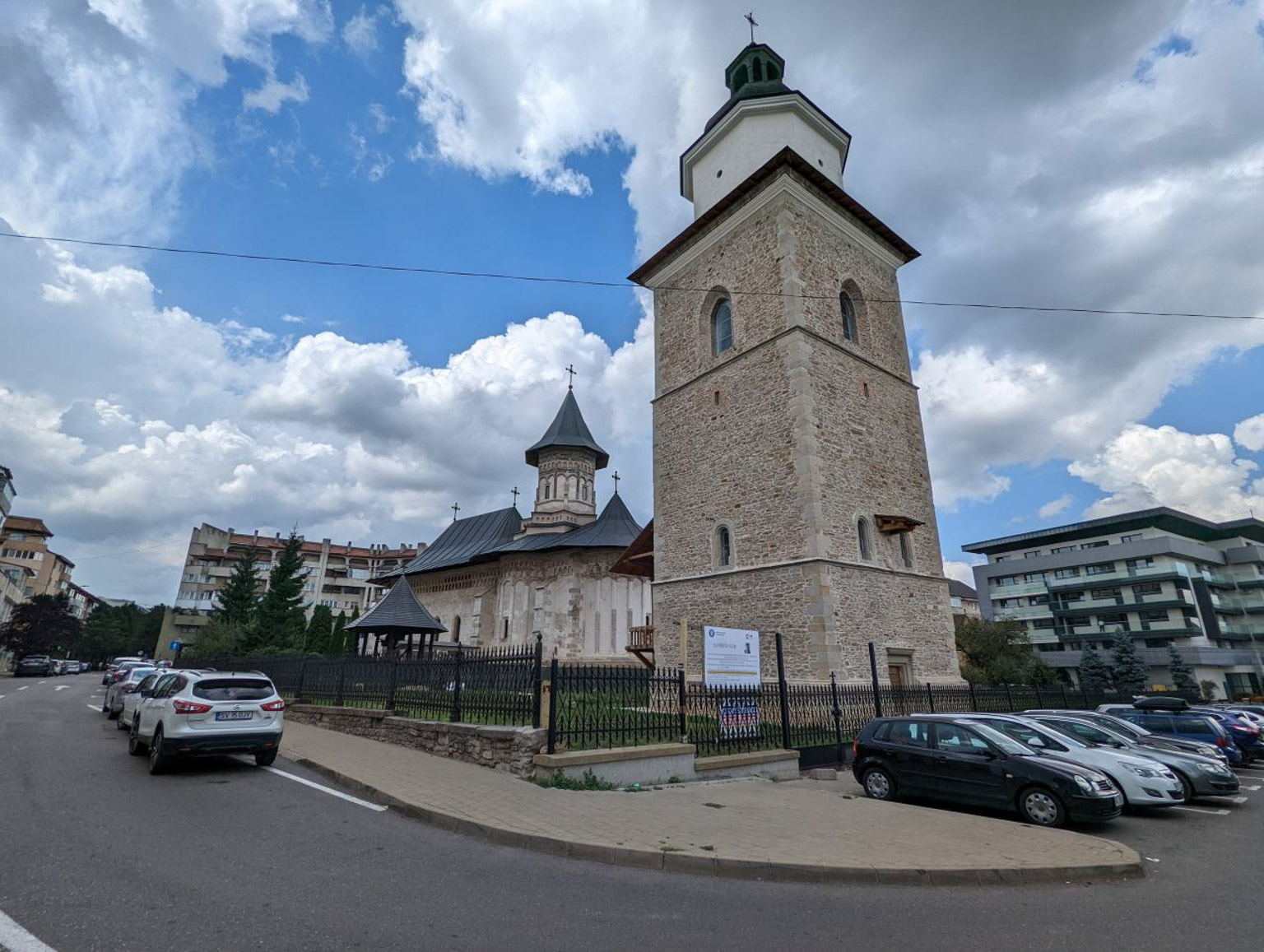
The Church of St. Dumitru, built between 1534-1535 and painted between 1535-1537, represents a foundation of Voivode Petru Rareș. By integrating the forms and balancing the volumes in a coherent ensemble, this church reflects the experience accumulated by the most important religious constructions during the reign of Petru Rareș. The monument stands out as an outstanding example of 16th-century Moldavian architecture, showing similarities with the Probota church in terms of the triconic plan, the beautiful spire on the nave and the specific elements of the Moldavian style, such as massive buttresses, decorated facades and large windows in gothic style.
The Pisania of the church is found on the southern facade, above the entrance door. Above the Slavic inscription, the country's coat of arms is surrounded by a wreath held by two angels. This representation of angels is an adaptation of a relief from the Sistine Chapel balustrade, created by the famous sculptor Mino da Fiesole. The way the angels are treated shows the influence of the Italian Renaissance art on the Moldavian sculpture of that period, highlighting the links established between the two around the middle of the 16th century.
The murals at the church of St. Demetrius appear extremely faded and damaged, making it difficult to identify a character or a scene without being able to fully distinguish the ensemble and the quality of the colors and design. Experts have noticed an almost perfect identity between the interior painting here and the one in the church of St. George.
In the nave, the votive painting was affected by the widening of the door in the middle wall, but the figures of Petru Rareș, Mrs. Elena and two children can still be seen. The ruler's face is more elongated, similar to that of Moldovita, and exudes more life, while the portrait of Mrs. Elena is rounder and exhibits a beauty that we do not find in the other portraits. Externally, traces of the painting are visible only on the southern facade of the church and on the tower, where holy officers with halos in relief can be distinguished.
Next to the church, on the eastern side, Alexandru Lăpușneanu built a bell tower with massive walls in 1561. On the eastern facade of the tower, above the entrance, there is an inscription with the coat of arms of Moldova, finely carved in stone. In the last century, an extension was added to the tower, intended to be used as a firehouse, which raised it to a height of 40 meters.
Source: Bucharest-Suceava and in Northern Moldova (Ministry of Tourism, 1977)